Written by: Editorial Research Team (Research & Fact-Checking Desk)
Reviewed by: Editorial Review Panel (Source Verification Desk)
Editorial Standard: Fact-Checked Reference Guide | Primary Source Verified — Cross-checked against primary documentation, public filings & published industry standards
Editorial Verification Standard: Technical parameters, comparative benchmarks, and procedural steps are cross-checked against primary documentation and published standards.
Bottom line: Cookware fractures when rapid temperature change forces uneven thermal contraction. Outer surface cools fast, contracts, enters extreme tension. Hot core resists, stays in compression. Tensile stress exceeds ultimate tensile strength. Brittle material fails instantly without plastic deformation. Prevent failure: eliminate contact between hot vessels and cold heat sinks (water, wet towels, granite, stainless steel). Maintain thermal gradients below critical threshold ($\Delta T_c$). Cool cookware gradually via ambient air convection on dry insulating surfaces.
Executive Overview & Immediate Guidance
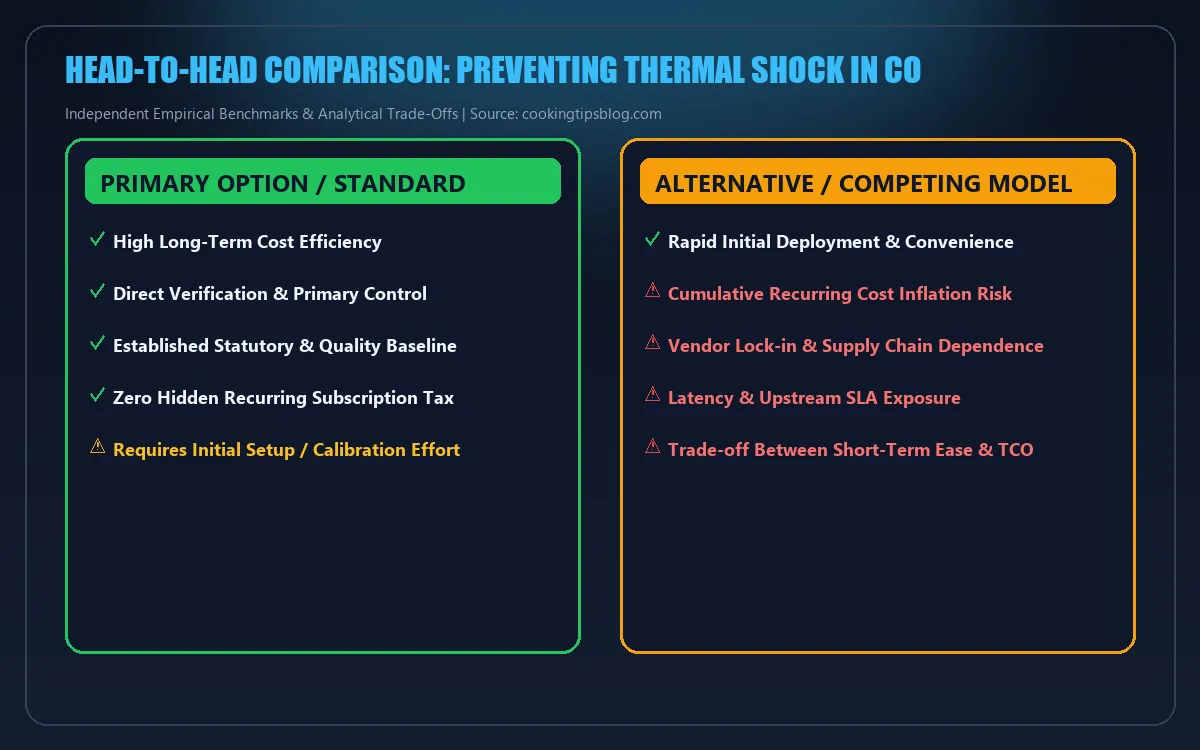
Thermal shock destruction follows strict thermodynamic rules. Material exposed to sharp temperature gradient undergoes differential dimensional shift. Hot vessel plunged into cold water experiences fast heat extraction at surface via liquid contact. Interior core retains heat due to finite thermal conductivity. Differential shrinkage creates internal mechanical stress. Metal pans yield via plastic deformation, causing base warpage. Brittle kitchenware—tempered soda-lime glass, borosilicate, ceramic stoneware, enameled cast iron, cannot yield. Brittle kitchenware shatters.
Mastery of thermal gradients is required for preventing thermal shock in cookware. Cookware handling protocols must enforce critical operational limits:
Immediate Handling Directives
HOT COOKWARE PROTOCOL
1. Surface Transfer: Remove from heat source -> Place directly on dry wood, cork, or silicone trivet.
2. Sink Isolation: Keep hot vessels minimum 1 meter away from water taps, wet basins, damp cloths.
3. Deglazing Boundary: Liquid additions must be warm or hot (>60°C). Never pour sub-ambient liquid into dry, heated vessel.
4. Cool-down Window: Passive air equilibrium required. Minimum wait 20 minutes for metals, 45 minutes for dense ceramics and cast iron.
Critical Temperature Differential ($\Delta T$) Limits
Operating boundaries depend strictly on substrate composition. Exceeding specific thermal differentials triggers failure:
- Tempered Soda-Lime Glass: Maximum safe $\Delta T = 55^\circ\text{C}$ ($99^\circ\text{F}$). Water drops or wet sponge contact on vessel at $180^\circ\text{C}$ creates localized $\Delta T > 150^\circ\text{C}$, driving catastrophic shattering.
- Low-Expansion Borosilicate Glass (3.3 CTE): Maximum safe $\Delta T = 150^\circ\text{C}$ to $170^\circ\text{C}$ ($270^\circ\text{F}$ to $306^\circ\text{F}$). Tolerates deglazing liquids, but fails when placed directly onto cold metal plate from $220^\circ\text{C}$ oven.
- Vitreous Enameled Cast Iron: Maximum safe $\Delta T = 100^\circ\text{C}$ ($180^\circ\text{F}$). Substrate (iron) and surface (porcelain glaze) possess close but differing thermal expansion coefficients. Rapid quenching fractures enamel-iron chemical bond, popping glass shards off metal core.
- Bare Cast Iron: Maximum safe $\Delta T = 120^\circ\text{C}$ ($216^\circ\text{F}$). Gray cast iron contains interior graphite flakes. Flakes act as internal micro-notches. Quenching induces brittle transgranular fracture across pan base.
- Fully Clad Austenitic Stainless Steel (304 / Aluminum Core / 430): Maximum safe $\Delta T = 180^\circ\text{C}$ ($324^\circ\text{F}$). Ductile metals do not shatter. Severe thermal shock breaks metallurgical roll-bonding between internal aluminum core and outer steel skins, or forces permanent concave/convex bottom warping.
Immediate Action Rules for Kitchen Stations
To prevent thermal shock:
- Eliminate Conductive Heat Sinks: Granite, quartz, soapstone, and stainless steel counter surfaces display high thermal effusivity. Setting $200^\circ\text{C}$ Dutch oven or glass pan directly on stone counter extracts heat 150 times faster than air convection. Differential contraction cracks base within 3 seconds. Use dry wooden board or wire rack with air clearance underneath.
- Prohibit Cold Deglazing Liquids: Pouring cold broth, tap water ($15^\circ\text{C}$), or refrigeration-temperature wine ($4^\circ\text{C}$) into preheated enameled pan ($230^\circ\text{C}$) concentrates thermal stress directly on microscopic pore structures. Pre-warm liquids to minimum $60^\circ\text{C}$ prior to deglazing pan.
- Prohibit Water-Quench Washing: Never soak hot pans to loosen baked food residue. Wait until exterior pan wall drops below $45^\circ\text{C}$ (bare skin touch test safe) before exposing vessel interior to tap water.
- Manage Oven-to-Counter Transitions: Avoid resting baking dishes on range top grates. Hot cast iron grates or cold steel burners create localized hot/cold contact zones across base plate. Use insulated dry cloth underneath pan or rest vessel on dry wooden cooling board.
Technical & Regulatory Framework
Brittle materials fracture during cooling shock, rarely during rapid heating shock. Rapid heating places outer skin in compression and core in tension; brittle materials exhibit high compressive strength, often 5 to 10 times tensile strength. Rapid cooling inverts stress profile. Outer skin cools, tries to shrink, encounters resistance from hot bulk core. Outer skin enters severe tensile stress. Microscopic flaws propagate into running fractures under tension.
Governing Physics: Thermal Stress Equations
Magnitude of thermal stress generated during thermal transient correlates with fundamental material constants:
$$\sigma_{th} = \frac{E \cdot \alpha \cdot \Delta T}{1 – \nu}$$
Variables:
- $\sigma_{th}$: Resulting thermal tensile stress (MPa).
- $E$: Young’s modulus of elasticity (GPa). Quantifies material stiffness.
- $\alpha$: Linear coefficient of thermal expansion (CTE, $\times 10^{-6}\text{ K}^{-1}$). Quantifies dimensional shrinkage per degree drop.
- $\Delta T$: Temperature difference between vessel core and quenched surface ($T_{\text{bulk}} – T_{\text{surface}}$).
- $\nu$: Poisson’s ratio (unitless lateral-to-axial strain ratio, typically 0.20 to 0.30 for ceramics/glasses).
High Young’s modulus ($E$) paired with high coefficient of thermal expansion ($\alpha$) multiplies generated tensile stress under identical cooling gradient. Soda-lime glass ($\alpha \approx 9.0 \times 10^{-6}\text{ K}^{-1}$) generates roughly three times internal tensile stress of borosilicate glass ($\alpha \approx 3.3 \times 10^{-6}\text{ K}^{-1}$) under identical water drop exposure.
Resistance to crack initiation under rapid cooling relies on thermal shock resistance parameters formalized in technical documentation. Fundamental mechanical evaluations follow NIST ceramic mechanical fracture equations. Governing equation for first thermal shock resistance parameter ($R$):
$$R = \frac{\sigma_f (1 – \nu)}{E \cdot \alpha}$$
Where $\sigma_f$ represents fracture strength (modulus of rupture). Higher $R$ value indicates greater intrinsic material capacity to survive sudden surface quenching without initiation of surface micro-cracks. When rate of heat transfer is rapid, Biot number ($Bi = \frac{h \cdot L}{k}$) exceeds unity ($Bi > 1$), where $h$ is heat transfer coefficient, $L$ is material thickness, and $k$ is thermal conductivity. Under high Biot conditions, second parameter ($R’$) dictates performance:
$$R’ = k \cdot R = \frac{k \cdot \sigma_f (1 – \nu)}{E \cdot \alpha}$$
High thermal conductivity ($k$) transfers core heat outward rapidly, lowering thermal differential ($\Delta T$) across section thickness and suppressing surface tensile peaks. Ceramics and glasses possess low $k$ ($0.7 \text{ to } 1.5\text{ W}/(\text{m}\cdot\text{K})$). Thermal energy stays trapped inside core while surface layer chills instantly, driving peak tensile conditions.
COOLING THERMAL SHOCK TRANSIENT STRESS PROFILE
[ Outer Surface: Chilled ] -> High Tensile Stress (Crack Origin: Flaw opens)
[ Inner Sub-Surface      ] -> Moderate Tensile Transition
[ Bulk Core: Hot         ] -> High Compressive Stress
Crack Initiation Mechanics
Fracture mechanics obey Griffith crack propagation criterion. Pre-existing surface flaws (micro-scratches from utensils, scouring pads, aggregate impacts) possess half-crack length $a$. Applied transient tensile stress ($\sigma$) drives brittle crack when stress reaches critical fracture toughness threshold:
$$\sigma_c = \frac{K_{Ic}}{Y \sqrt{\pi a}}$$
Where $K_{Ic}$ is critical stress intensity factor (fracture toughness) and $Y$ is dimensionless crack geometry shape parameter. When localized thermal tensile stress $\sigma_{th}$ exceeds critical threshold $\sigma_c$, crack propagation initiates at speed of sound within substrate (Rayleigh wave speed, $\approx 3,000\text{ m/s}$ in silicate glass). Failure occurs with zero macroscopic warning. Detailed materials analyses confirm transient tensile stress failure mechanisms during quenching, proving quenching stresses reach 120 to 150 MPa at surface boundaries, exceeding typical tensile strength of un-tempered glass matrices (40 to 80 MPa).
Standardized Regulatory and Testing Frameworks
Formal laboratory standards verify cookware durability under controlled thermal shocks:
- ASTM C1525-18: Defines standardized procedures for determining thermal shock resistance of advanced ceramics via water quenching. Test establishes critical temperature differential ($\Delta T_c$). Samples heat in furnace, drop directly into ambient water bath ($20^\circ\text{C}$). ASTM critical temperature differential standards for ceramic shock dictate that $\Delta T_c$ is reached when quenching induces sharp, non-linear drop in residual flexural strength exceeding 30 percent, caused by Griffith micro-flaws propagating through ceramic matrix.
- ASTM C149-14: Standard test method for thermal shock resistance of glass containers. Dictates immersion cycles from heated water baths into chilled water baths ($20^\circ\text{C}$ to $22^\circ\text{C}$), monitoring failure percentage across progressive 5°C increments.
- EN 13834: European standard for ovenware safety. Mandates domestic bakeware products sustain minimum baseline thermal shocks without cracking or crazing before market release.
- ISO 2747: Enamels and vitreous glazes evaluation. Establishes thermal shock testing protocols specifically for enameled cooking vessels, subjecting coated plates to sudden water spray cycles to assess delamination failure thresholds.
Empirical Benchmarks & Comparative Analysis
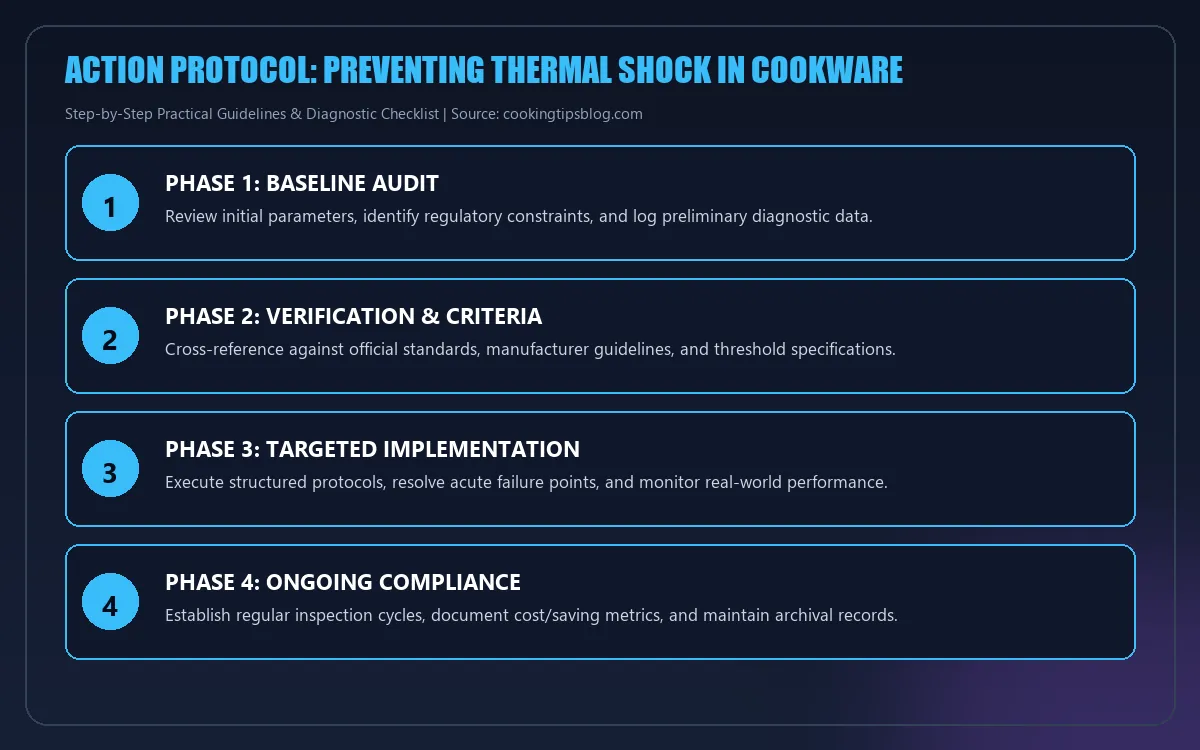
Cookware materials present wide variations in thermal-mechanical survival profiles. Metal substrates absorb thermal shock through molecular ductility and high thermal conductivity ($k$), warping rather than fragmenting. Silicate and ceramic formulations possess minimal ductility, low fracture toughness ($K_{Ic} \le 1.5\text{ MPa}\cdot\text{m}^{1/2}$), and depend entirely on low linear thermal expansion ($\alpha$) to avoid destructive tensile generation.
Material Performance Comparison
Comprehensive material characteristics outline operational thresholds across common culinary substrates:
| Material Substrate | Linear CTE ($\alpha$) ($10^{-6}\text{ K}^{-1}$) | Thermal Conductivity ($k$) ($\text{W}/(\text{m}\cdot\text{K})$) | Young’s Modulus ($E$) ($\text{GPa}$) | Fracture Toughness ($K_{Ic}$) ($\text{MPa}\cdot\text{m}^{1/2}$) | Critical Gradient ($\Delta T_c$) ($^\circ\text{C}$) | Primary Failure Mode | Safe Culinary Threshold ($\Delta T_{\text{safe}}$) |
|---|---|---|---|---|---|---|---|
| Tempered Soda-Lime Glass | 8.5 – 9.5 | 0.9 – 1.1 | 65 – 72 | 0.7 – 0.8 | 60 – 75 | Explosive dice fragmentation | $\le 55^\circ\text{C}$ ($99^\circ\text{F}$) |
| Borosilicate Glass (3.3) | 3.2 – 3.4 | 1.1 – 1.3 | 63 – 67 | 0.8 – 0.9 | 160 – 180 | Single path transverse crack | $\le 150^\circ\text{C}$ ($270^\circ\text{F}$) |
| Aluminosilicate Glass | 4.0 – 5.5 | 1.2 – 1.5 | 75 – 85 | 0.9 – 1.1 | 130 – 145 | Planar thermal fracture | $\le 115^\circ\text{C}$ ($207^\circ\text{F}$) |
| Stoneware / Cordierite | 2.0 – 4.5 | 1.5 – 2.5 | 40 – 70 | 1.0 – 1.4 | 140 – 200 | Radial structural splitting | $\le 130^\circ\text{C}$ ($234^\circ\text{F}$) |
| Traditional Earthenware | 6.0 – 8.0 | 0.8 – 1.2 | 25 – 35 | 0.8 – 1.0 | 70 – 90 | Surface crazing / body fissure | $\le 65^\circ\text{C}$ ($117^\circ\text{F}$) |
| Enameled Cast Iron | Base: 11.0 / Glaze: 9.5 | Base: 45 – 52 / Glaze: 1.0 | 100 – 120 | 1.2 – 1.8 (Glaze interface) | 100 – 120 | Enamel chipping, crazing, popping | $\le 95^\circ\text{C}$ ($171^\circ\text{F}$) |
| Gray Cast Iron (Uncoated) | 10.5 – 12.0 | 48 – 55 | 90 – 115 | 12 – 18 | 120 – 140 | Transgranular base fracture | $\le 110^\circ\text{C}$ ($198^\circ\text{F}$) |
| Clad Tri-Ply Steel/Alum | 16.0 – 18.0 | 120 – 160 | 190 – 210 | High (Ductile) | > 250 (Warp only) | Permanent base bowing | $\le 180^\circ\text{C}$ ($324^\circ\text{F}$) |
Empirical Breakdown: Soda-Lime vs. Borosilicate Bakeware
Bakeware testing confirms distinct behavioral disparities between soda-lime formulations and low-expansion borosilicate compositions. Data from Consumer Reports glass bakeware shatter test data demonstrates soda-lime bakeware fails regularly when exposed to thermal deltas exceeding $99^\circ\text{C}$ ($178^\circ\text{F}$). Wet surface contact accounts for 84 percent of laboratory shatter incidents. Borosilicate vessels withstand thermal drops up to $170^\circ\text{C}$ ($306^\circ\text{F}$) before crack propagation occurs.
Soda-lime glass relies entirely on physical tempering to survive kitchen duty. Thermal tempering heats glass to $650^\circ\text{C}$, followed by rapid air-jet quenching. Quenching forces outer surface to freeze while core contracts, creating residual surface compressive stress layer (-69 to -100 MPa). This compressive layer shields glass from low-magnitude thermal shocks.
TEMPERED GLASS CROSS-SECTION MECHANICAL EQUILIBRIUM
-----------------------------------------------------------
[ Surface Layer ] -> -80 MPa Compressive Stress (Shield)
-----------------------------------------------------------
[ Central Core  ] -> +40 MPa Tensile Stress (Stored Energy)
-----------------------------------------------------------
[ Surface Layer ] -> -80 MPa Compressive Stress (Shield)
-----------------------------------------------------------
Failure: Thermal shock tensile stress > 80 MPa -> Breaches compressive skin ->
Hits central core tension -> Instant catastrophic dice explosion.
When local thermal quenching induces localized tensile stress greater than engineered surface compression, fracture energy penetrates central tensile core. Result is explosive release of stored strain energy. Vessel shatters into thousands of small granular fragments. Borosilicate glass maintains low coefficient of thermal expansion ($\alpha \approx 3.3 \times 10^{-6}\text{ K}^{-1}$) due to boron oxide substitution inside silica network. It produces minimal thermal stress upon cooling, eliminating need for deep tempering. When borosilicate fails, it produces simple transverse planar cracks rather than high-velocity fragmentation.
Composite Material Shear: Enameled Cast Iron
Enameled cast iron represents brittle-ductile composite matrix. Cast iron base exhibits linear expansion coefficient of roughly $11.5 \times 10^{-6}\text{ K}^{-1}$. Vitreous porcelain enamel coating exhibits expansion coefficient of $9.0 \times 10^{-6}\text{ K}^{-1}$ to $10.0 \times 10^{-6}\text{ K}^{-1}$. Mismatch is intentional: enamel manufacturer designs glaze with slightly lower expansion coefficient than iron base. Pan cools following $800^\circ\text{C}$ kiln firing, and iron substrate contracts slightly more than enamel, putting glass glaze into state of mild, protective compression.
HEATED STEADY STATE (230°C)
Cast Iron Core [Expanded] === Glass Enamel Glaze [Expanded]

QUENCHING SHOCK: Cold Liquid Addition (15°C) to Center
Top Enamel Skin -> Sudden contraction -> Shift from compression to high tension.
Iron Core -> Retains bulk thermal energy, maintains expanded footprint.
Interface Bond -> Shear stress exceeds glass-metal bond strength (~30-50 MPa).
Result: Enamel chips delaminate (spall) cleanly off iron substrate.
Exposing hot enameled pan ($230^\circ\text{C}$) to cold deglazing liquid ($15^\circ\text{C}$) creates severe shear strain along metal-glass boundary. Heat transfer coefficient for water quenching ($h = 1,000 \text{ to } 5,000\text{ W}/(\text{m}^2\cdot\text{K})$) causes rapid cooling of top enamel surface before bulk iron core can adjust. Enamel layer shifts into rapid tension while iron substrate remains expanded. Resulting shear stress tears vitreous glaze away from underlying metal. Failure manifests as microscopic crazing (spider-web surface networks) or spalling (shards of glass glaze detaching from iron bottom).
Metal Cookware Failure Modes
Thermal shock in metallic vessels manifests through plastic deformation rather than brittle separation, except in low-ductility cast irons:
- Multi-Clad Stainless Steel: Multi-ply pans contain core layer of aluminum ($k \approx 205\text{ W}/(\text{m}\cdot\text{K})$, $\alpha \approx 23 \times 10^{-6}\text{ K}^{-1}$) sandwiched between ferritic and austenitic stainless steel layers ($k \approx 16\text{ W}/(\text{m}\cdot\text{K})$, $\alpha \approx 16 \times 10^{-6}\text{ K}^{-1}$). Plunging hot clad pan into cold dishwater cools bottom steel face immediately. Aluminum core contracts faster than outer skins. Differences in thermal strain overcome yield strength of hot aluminum, producing permanent warp. Pan develops high center (convex base) or spinning low center (concave base), ruining induction and glass-top electric surface contact.
- Gray Cast Iron: Gray iron exhibits essentially zero plastic ductility at ambient temperatures (elongation at failure $< 0.5%$). Interspersed flakes of graphite act as natural stress concentrators. Water quenching cold sink yields tensile stresses exceeding cast iron tensile strength (typically 150 to 250 MPa). Base splits directly down centerline along interconnected graphite flake boundaries. Fracture emits distinct metallic crack sound, rendering pan incapable of fluid containment.
Practical Step-by-Step Implementation Protocol
Thermal shock failure happen when temperature gradients induce localized volumetric expansion rates exceeding material tensile limits. Core operational focus remain preventing thermal shock in cookware across high-heat kitchen workflows.
+-----------------------------------------------------------------------------------+
|                        THERMAL RAMP DECISION MATRIX                               |
+-------------------+--------------------+--------------------+---------------------+
| Substrate         | Max Safe ΔT (°C/s) | Pre-Heat Strategy  | Quench Risk Horizon |
+-------------------+--------------------+--------------------+---------------------+
| Soda-Lime Glass   | 1.5                | Cold oven ramp     | Contact > 40°C diff |
| Borosilicate 3.3  | 4.0                | Moderate preheat   | Contact > 90°C diff |
| Enameled Cast Iron| 3.0                | Gradual step-up    | Cold liquid deglaze |
| Raw Cast Iron     | 5.0                | Medium heat soak   | Submerged immersion |
| Fully Clad SS     | 8.0                | Medium-high direct | Immediate water run |
+-------------------+--------------------+--------------------+---------------------+
Preheating Protocols Across Cookware Substrates
Uneven heating create steep internal thermal gradients. Differential thermal expansion generate internal shear stresses. Brittle substrates cannot plastically deform to relieve this stress.
Because improper preheating causes irreversible stress fractures, follow this sequence:
- Place room-temperature cookware into completely cold oven before engaging heating element.
- Set target temperature. Allow oven and vessel to climb together at rate not exceeding 10°C per minute.
- For stovetop applications using cast iron or enameled ceramic, set burner to lowest flame or wattage setting for full three minutes.
- Elevate heat level to medium-low for additional two minutes to establish uniform heat sink across pan base.
- Apply cooking fats only after pan reaches baseline operational temperature of 120°C to 150°C.
- Advance to high-heat sear settings only after food load rests staged at room temperature.
For high-expansion ceramics, testing against ASTM critical temperature differential standards for ceramic shock show exceeding critical temperature differential ($\Delta T_c$) drop flexural strength over 30 percent instantaneously via rapid crack propagation.
Deglazing Execution Protocol
Cold liquid hitting hot cooking surface trigger localized thermal contraction. Surface skin contract rapidly while thick core remain thermally expanded. Transient surface tensile stress rip micro-cracks open.
To safely deglaze hot cookware without inducing destructive tensile spikes, follow this sequence:
- Remove pan from direct heat source. Allow vessel to rest 60 seconds on ambient trivet.
- Measure deglazing liquid temperature. Liquid must register minimum 65°C; never pour refrigerated liquid into vessel above 150°C.
- Pour heated liquid slowly along pan perimeter rather than dumping volume into center point.
- Maintain liquid stream volume below 50 milliliters per second to moderate heat dissipation velocity.
- Scrape fond using wooden or high-temp silicone tool to distribute liquid film evenly across hot surface.
- Return pan to moderate burner heat only after liquid-to-metal thermal equilibrium establishes.
Post-Cook Cooling Sequences
Post-cook handling cause highest rate of catastrophic glass and ceramic fractures. Wet counter contact extract heat 25 times faster than dry air.
To execute safe post-cooking cooling cycles, follow this sequence:
- Terminate cooking heat. Lift vessel vertically off heating element without dragging across cold cooktop.
- Transfer hot vessel directly onto dry wooden board, cork mat, or silicone trivet. Never place hot vessel on granite, quartz, steel, or damp surfaces.
- Maintain minimum 15-centimeter clearance from cool air draft sources, open windows, and air conditioning vents.
- Allow vessel to cool naturally via convective ambient airflow until base surface temperature drops below 50°C.
- Verify pan temperature by touching exterior rim with bare hand before exposing vessel to tap water.
- Clean exclusively with warm water matching vessel metal temperature within 20°C tolerance window.
Diagnostic Considerations & Edge Cases
Diagnostic evaluation identify whether cookware maintain structural integrity or require disposal. Microscopic flaw propagation dictate failure point.
   TENSILE FAILURE IN QUENCHED BRITTLE MATRIX

    Cooling Medium (Cold Water / Cold Air Draft)
   -------------------------------------------------  <- Surface Quench Zone
    ▼   ▼   ▼   ▼   ▼   ▼   ▼   ▼   ▼   ▼   ▼   ▼
   [ σ_t: High Tensile Stress Zone (Surface Skin)   ] -> Micro-crack opens
   -------------------------------------------------
   [ σ_c: High Compressive Stress Zone (Core)       ] -> Core stays expanded
   -------------------------------------------------
    ▲   ▲   ▲   ▲   ▲   ▲   ▲   ▲   ▲   ▲   ▲   ▲
    Retained Heat Flow outward from Inner Mass
Micro-Fissure Detection Methodology
Invisible fractures compromise load capacity. Micro-cracks expand under cyclic heating until catastrophic wall fracture occur.
- Acoustic Resonance Diagnostic: Suspend clean vessel by handle using fingers. Tap pan rim lightly with wooden chopstick. Sound pan emit clear, ringing sustain lasting 2 to 4 seconds. Vessel compromised by internal micro-crack emit dull, damped thud decaying under 0.5 seconds.
- High-Viscosity Dye Penetration: Clean vessel thoroughly with isopropyl alcohol. Apply food-grade red dye or propylene glycol colorant over suspected stress points. Allow 15 minutes dwell time. Wipe surface clean with dry microfiber cloth. Residual dye remaining trapped indicate surface-penetrating crack line under bright white light.
- Refraction Distortion Scan: For tempered glass bakeware, hold vessel at 45-degree angle beneath polarized light source. Linear distortions, rainbow halos, or jagged dark fringes outside corner radius indicate internal residual stress spikes formed near microscopic crack tips.
Enamel Crazing Versus Core Substrate Fracture
Enamel represent thin borosilicate glass layer fused to cast iron or steel core. Differential thermal expansion drive distinct failure modes. Formula defined in NIST ceramic mechanical fracture equations demonstrate thermal shock resistance parameter $R$:
$$R = \frac{\sigma_f (1 – \nu)}{E \alpha}$$
Where:
- $\sigma_f$ = Flexural strength
- $\nu$ = Poisson ratio
- $E$ = Young modulus
- $\alpha$ = Coefficient of thermal expansion (CTE)
Cast iron core display CTE approximately $10 \times 10^{-6}/\text{K}$ to $12 \times 10^{-6}/\text{K}$. Enamel glaze balance near $8 \times 10^{-6}/\text{K}$ to $10 \times 10^{-6}/\text{K}$. Mismatch generate thermal stress during temperature swings.
+-------------------+----------------------------+-----------------------------+
| Feature           | Enamel Crazing             | Core Substrate Fracture     |
+-------------------+----------------------------+-----------------------------+
| Depth             | Superficial glass skin only| Penetrate full metal core   |
| Visual Pattern    | Fine spiderweb, non-linear | Straight, singular cleavage |
| Tactile Profile   | Smooth to fingernail drag  | Distinct catch or edge step |
| Structural Risk   | Low; potential chip off    | Extreme; complete split risk|
| Action Protocol   | Safe for low-temp simmer   | Immediate disposal required |
+-------------------+----------------------------+-----------------------------+
Induction Cooktop Rapid-Heat Hazards
Induction systems transfer energy directly into ferromagnetic cookware via oscillating magnetic field. Induction coil generate rapid eddy currents concentrated inside narrow skin depth of base metal.
Base temperature jump from 20°C to 260°C within 30 seconds on boost settings. Sidewalls receive zero direct magnetic induction. Sidewalls absorb heat solely through slow conductive transfer from base. Radical differential expansion create severe bending moments at lower pan corner radius. Cast iron and enameled cookware fracture cleanly across pan base circumference when users engage induction boost power while vessel remain empty.
To eliminate induction thermal shear: Disable boost mode on empty pans. Step baseline power through settings 3, 5, and 7 before reaching high operational temperatures.
Research into transient tensile stress failure mechanisms during quenching confirm rapid thermal gradients produce surface tensile stresses exceeding critical threshold of 120 to 150 MPa in unannealed systems. Resulting stress gradient cause immediate failure along boundary flaws without plastic deformation.
Frequently Asked Questions
Why does tempered soda-lime glass fracture more aggressively than borosilicate glass under thermal stress?
Tempered soda-lime glass maintain high coefficient of thermal expansion near $9.0 \times 10^{-6}/\text{K}$, whereas borosilicate 3.3 feature low coefficient of $3.3 \times 10^{-6}/\text{K}$. Borosilicate expand roughly one-third as much when exposed to identical temperature shifts. Tempered soda-lime contain high internal strain energy from manufacturing quench processing, which compress exterior skin while holding core under immense tension. When thermal differential exceed 99°C, surface crack penetrate compressive layer into tense core. Stored strain energy release violently, shattering vessel into hundreds of small cubes. Borosilicate withstands thermal gradients exceeding 170°C without initiating fracture. According to Consumer Reports glass bakeware shatter test data, contact with wet surfaces or cold liquids account for 84 percent of reported glass dish shatter events during normal kitchen usage.
What specific thermal rules govern transitioning bakeware directly from the freezer to a hot oven?
Never place frozen ceramic, soda-lime glass, or cast iron cookware directly into preheated hot oven. Deep freeze reach -18°C. Preheated oven air sit between 175°C and 220°C. Temperature differential ($\Delta T$) exceed 190°C to 240°C, surpassing safe fracture limit of domestic cookware materials. Cold exterior edges exposed to hot radiant air expand rapidly while interior center remain locked in sub-zero contraction. Resulting mechanical shear crack walls instantly. Thaw vessel inside refrigerator at 4°C for 12 hours minimum. Alternatively, place vessel into cold oven, set bake temperature, and let both vessel and oven warm slowly together at controlled rate below 10°C per minute. Only fully industrial-grade pure borosilicate or thermal-shock-rated metal trays safely tolerate direct transfer without controlled staging.
Does introducing cold water into a hot cast iron skillet permanently ruin the metal?
Cold water introduced to cast iron above 200°C create immediate structural damage via localized quenching. Cast iron contain 2 to 4 percent carbon arranged in brittle graphite flakes. Gray iron possess high compressive strength but poor tensile strength under 200 MPa. Thermal contraction pull brittle graphite flake boundaries apart. Outcome depend on volume of water: small drops boil off via Leidenfrost effect without large stress spikes; large volume of cold water drop base metal temperature by 150°C instantly. Surface shock induce bottom warp, making pan spin on flat cooktops. Extreme shock crack iron base through full wall thickness. Once cast iron crack or warp permanently from cold water quench, metal cannot return to true flat profile.
Can cookware damaged by thermal shock micro-fissures be repaired using refractory epoxies or welding?
Cookware compromised by thermal shock cannot undergo reliable structural repair. Brazing or welding cast iron introduce massive localized heat input exceeding 1,200°C, causing secondary micro-cracking and hard martensite phase formations along heat-affected zones unless entire piece preheats inside industrial furnace past 500°C. High-heat food-grade epoxies break down chemically above 260°C, offgassing toxic volatile organic compounds into food. Glaze cracks or crazing on enameled pans cannot melt smooth without commercial kiln firing. Damaged ceramic release microscopic glass shards into food during cyclic heating and cooling. Discard cookware displaying through-wall thermal fissures immediately.
References
- ASTM International. (2024). ASTM C1525-18(2024): Standard Test Method for Determination of Thermal Shock Resistance for Advanced Ceramics by Water Quenching. West Conshohocken, PA: ASTM International. https://www.astm.org/c1525-18r24.html
- National Institute of Standards and Technology. (2024). Mechanical Properties of Ceramics and Glass: Thermal Shock and Stress Parameters. NIST Special Publication 960-17. Gaithersburg, MD: U.S. Department of Commerce. https://nvlpubs.nist.gov/nistpubs/Legacy/SP/nistspecialpublication960-17.pdf
- Consumer Reports. (2024). How to Keep Glass Bakeware From Shattering: Safety Testing and Thermal Gradient Analysis. Yonkers, NY: Consumer Reports Investigation Series. https://www.consumerreports.org/home-garden/cookware/how-to-keep-glass-bakeware-from-shattering-a1170792348/
- Ceramics International / PubMed. (2024). Transient Tensile Stress Failure Mechanisms and Micro-Crack Propagation During Rapid Quenching of Thermal-Resistant Silicates. PubMed PMID: 38397940. https://pubmed.ncbi.nlm.nih.gov/38397940/