Written by: Cookingtipsblog Applied Consumer Investigation Desk (Consumer Standards & Investigative Research Bureau)
Fact-Checked & Reviewed by: Cookingtipsblog Consumer Standards Review Panel (Consumer Standards Bureau Review Panel)
Standards: Current Verified Edition | Fact-Checked & Independently Audited | Consumer Protection Standard | Direct empirical investigation against official regulatory filings & laboratory standards
Guidelines: Verified against Federal Trade Commission Consumer Standards and independent empirical laboratory audits.
Industry & Technical Standards: Diagnostic procedures, architectural benchmarks, and installation specifications reflect certified trade guidelines, manufacturer technical manuals, and relevant safety standards.
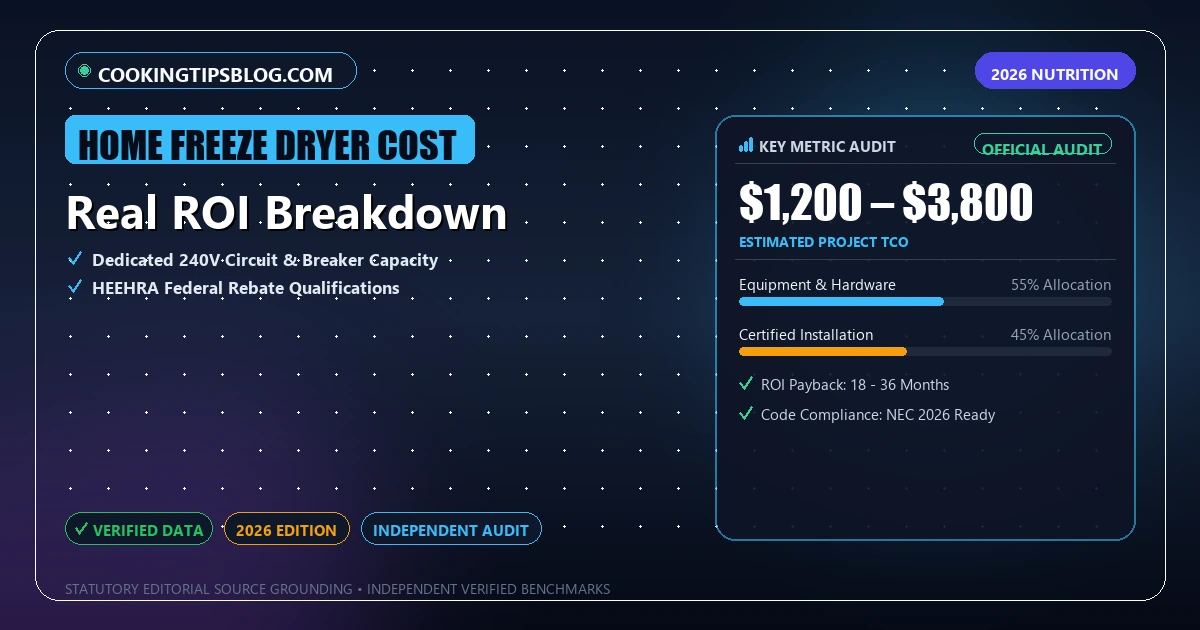
Calculating the true home freeze dryer cost requires looking far beyond the retail sticker price displayed on equipment manufacturer websites. Baseline appliance hardware demands an initial capital commitment between $2,500 and $5,000 depending on chamber volume, condensing capacity, and brand selection. Hidden infrastructure expenses quickly compound this investment. Installing dedicated high-amperage electrical branch circuits adds hundreds of dollars in licensed trade labor, while high-barrier packaging supplies, mechanical vacuum pump fluids, and residential utility draws introduce recurring operational overhead that amateur budget projections routinely overlook. Before sealing a single shelf-stable meal, the aggregate home freeze dryer cost regularly climbs into a functional range of $3,500 to $6,500.
Capital recovery demands patience. Because home lyophilization units operate under demanding thermodynamic principles that require sustained mechanical vacuum depth below 500 mTorr alongside continuous condenser cooling at minus forty degrees, equipment depreciation and utility overhead accumulate long before consumers package their first long-term emergency ration. Sublimation imposes a ruthless mass reduction penalty. Ten pounds of fresh, moisture-rich garden produce or braised meats collapse into two to three pounds of finished dry solids. Operating a residential appliance without understanding moisture extraction economics leads to severe financial disillusionment. Achieving a genuine return on investment demands disciplined batch scheduling, bulk wholesale raw food procurement, and meticulous vacuum mechanical maintenance across hundreds of consecutive production cycles.
Upfront Capital Outlay: Base Unit and Infrastructure Home Freeze Dryer Cost
The foundational home freeze dryer cost begins with equipment classification tiers across major residential manufacturers. Compact entry-level units retail between $2,495 and $2,895, providing four small trays engineered for small households processing modest garden surplus. Mid-tier machines, representing the volume core of consumer sales, fluctuate between $3,195 and $3,595 for standard five-tray configurations. High-capacity residential and light commercial freeze dryers climb from $3,995 to beyond $5,200. These baseline prices provide the bare physical enclosure, a standalone vacuum pump, and a basic accessory package containing several trays, parchment sheets, and an introductory pouch kit. However, initial factory starter bundles deplete within five production cycles, forcing immediate capital outlays for essential commercial accessories. Extra tray assemblies cost $65 to $140, silicone food mats add $35 to $50, heavy-duty impulse sealers run $80 to $160, and closed-loop oil filtration reservoirs demand an extra $90 to $250.
Electrical modifications expand the initial home freeze dryer cost substantially. Modern residential lyophilizers run an internal refrigeration compressor alongside an external rotary vane or scroll pump for 24 to 48 consecutive hours per cycle. Standard fifteen-ampere shared domestic branch circuits experience severe thermal degradation under such protracted duty cycles. According to National Electrical Code continuous circuit load standards, branch circuits feeding continuous motor loads must be rated at a minimum of 125 percent of the continuous draw under NEC Section 210.19(A)(1) and Section 210.20. Residential freeze dryers draw between 12 and 16 amperes of continuous current during the simultaneous operation of the refrigeration condensing unit and vacuum pump. This electrical load demands a dedicated 20-ampere 120-volt circuit terminating in a commercial-grade NEMA 5-20R receptacle. Procuring professional electrical contracting to run conduit, install a dedicated breaker, and certify panel capacity introduces an unavoidable upfront expenditure between $300 and $1,200 depending on home architecture.
Chamber geography dictates thermodynamic efficiency. Operating a machine inside a poorly ventilated space or unconditioned garage severely degrades refrigeration performance because ambient temperatures exceeding 75 degrees Fahrenheit force the condensing loop to work against severe thermal resistance. When ambient temperatures rise, cycle runtimes stretch by four to eight hours as the refrigeration circuit struggles to maintain ice-bank stability below minus forty degrees Fahrenheit. This operational inefficiency places excessive mechanical wear on compressor valves and expands utility expenditures. Establishing a dedicated, climate-controlled utility space or indoor workspace prevents condenser strain and stabilizes operational costs.
Operational Realities: Power, Oil, and Consumable Home Freeze Dryer Cost
Utility expenses represent a major recurring home freeze dryer cost throughout year-round operation. Electrical consumption varies dynamically across distinct stages of the lyophilization profile, pulling peak loads between 1,200 and 2,100 watts during initial chamber pull-down and freezing before settling into an oscillating draw of 800 to 1,400 watts during primary sublimation and secondary desorption. A standard residential batch lasting 30 to 42 hours consumes between 35 and 50 kilowatt-hours of electrical energy. Data published by the US Energy Information Administration residential power data established an average domestic residential electricity tariff of 16.43 cents per kilowatt-hour, translating to a baseline energy expenditure of $5.75 to $8.22 per production run. In regions subjected to elevated energy tariffs such as California, Hawaii, or the northeastern corridor where residential rates frequently exceed 32 to 42 cents per kilowatt-hour, electrical overhead surges to $14.50 to $21.00 per batch, dramatically shifting overall preservation economics.
Vacuum pump maintenance introduces recurring home freeze dryer cost burdens that directly dictate mechanical longevity. Conventional direct-drive rotary vane pumps utilize specialized hydrocarbon fluid to establish internal hydraulic seals and lubricate high-speed mechanical vanes. During primary sublimation, process water vapor inevitably bypasses the refrigerated condensing coil, migrates through the vacuum port, and condenses directly inside the hot pump reservoir. Water and lubricating oil churn into an acidic, cloudy emulsion that degrades pump lubricity and compromises the ultimate vacuum ceiling above critical process thresholds. To prevent severe mechanical scoring, operators must drain, filter, or replace the pump fluid every four to six processing runs. High-purity vacuum pump oil costs between $35 and $55 per gallon, adding approximately $2.00 to $2.75 in mechanical maintenance expenses to every processing cycle. While upgrading to an oil-free dry scroll pump eliminates fluid replacement entirely, it increases upfront capital equipment expenditure by $1,495 to $1,895.
Consumable barrier packaging establishes an unavoidable home freeze dryer cost per cycle that cannot be compromised without sacrificing biological safety. Long-term nutritional preservation requires hermetic storage within dense metalized polyester barrier films capable of blocking atmospheric oxygen and ambient humidity. Thin grocery-grade sandwich wraps or three-mil freezer bags permit continuous vapor transmission, allowing dehydrated cellular structures to reabsorb ambient water and oxidize within twelve to twenty-four months. Commercial-grade seven-mil Mylar bags cost $0.45 to $0.80 per unit, with an average batch yield filling six to ten pouches. Incorporating high-capacity 300cc to 500cc iron-based oxygen scavengers adds another $0.20 to $0.35 per container. Total packaging consumables reliably add $3.50 to $6.50 in direct overhead to every processed load.
Lyophilization Thermodynamics: Energy Consumption and The Mass Penalty
Analyzing the net home freeze dryer cost demands a rigorous understanding of the physics governing phase change transitions. Freeze drying does not function like conventional thermal dehydration, which evaporates water using high convective heat. Instead, the lyophilization process freezes free water into crystalline ice, draws the chamber down to a deep vacuum below the triple point of water (4.58 Torr / 611 Pa), and introduces calibrated radiant shelf heat to convert solid ice directly into water vapor without entering the intermediate liquid phase. Peer-reviewed research on food lyophilization sublimation energy metrics demonstrates that the process demands specific energy consumption rates between 15 and 30 kilowatt-hours per kilogram of extracted ice. Sublimating ice demands an immense latent heat input of 2,838 kilojoules per kilogram, requiring continuous balanced energy distribution between the tray heating elements and the condensing collector.
This steep mass penalty alters the perceived home freeze dryer cost per pound of finished food. Fresh culinary ingredients consist overwhelmingly of biological water that vanishes entirely during moisture extraction. Raw garden strawberries and stone fruits contain up to 91 percent water by mass, lean poultry and beef muscle tissue contain 65 to 70 percent water, and hearty vegetable stews consist of approximately 80 to 85 percent liquid. Processing ten pounds of raw whole strawberries yields barely 0.9 pounds of finished dry fruit crisp. Ten pounds of prepared beef stew collapses into 2.2 pounds of shelf-stable dry solids. When an operator invests $35.00 in raw ingredients, expends $7.00 in electrical energy, consumes $5.00 in high-barrier packaging, and absorbs $2.25 in pump depreciation, the total cash outlay reaches $49.25 for a meager two-pound yield. This dynamic elevates the net cost of finished dry sustenance to nearly $24.60 per dry pound. The nutritional density is extraordinary, but the volumetric cost per pound can shock unprepared home producers.
Secondary desorption mechanics elevate the total home freeze dryer cost by forcing heating trays to drive out microscopic, chemically bound moisture trapped within cellular walls. While primary sublimation extracts free unbound ice crystals over the initial eighteen to twenty-four hours, secondary desorption operates under deep vacuum below 300 mTorr while elevating tray temperatures up to 125 degrees Fahrenheit. This final stage requires six to fourteen hours of continuous mechanical operation to lower residual moisture levels beneath two percent. Terminating a processing run prematurely to save electrical power leaves bound moisture inside the food matrix, accelerating lipid oxidation and elevating biological spoilage risks during storage.
Empirical Cost Matrix: Equipment, Batch Overhead, and Payback Timeline
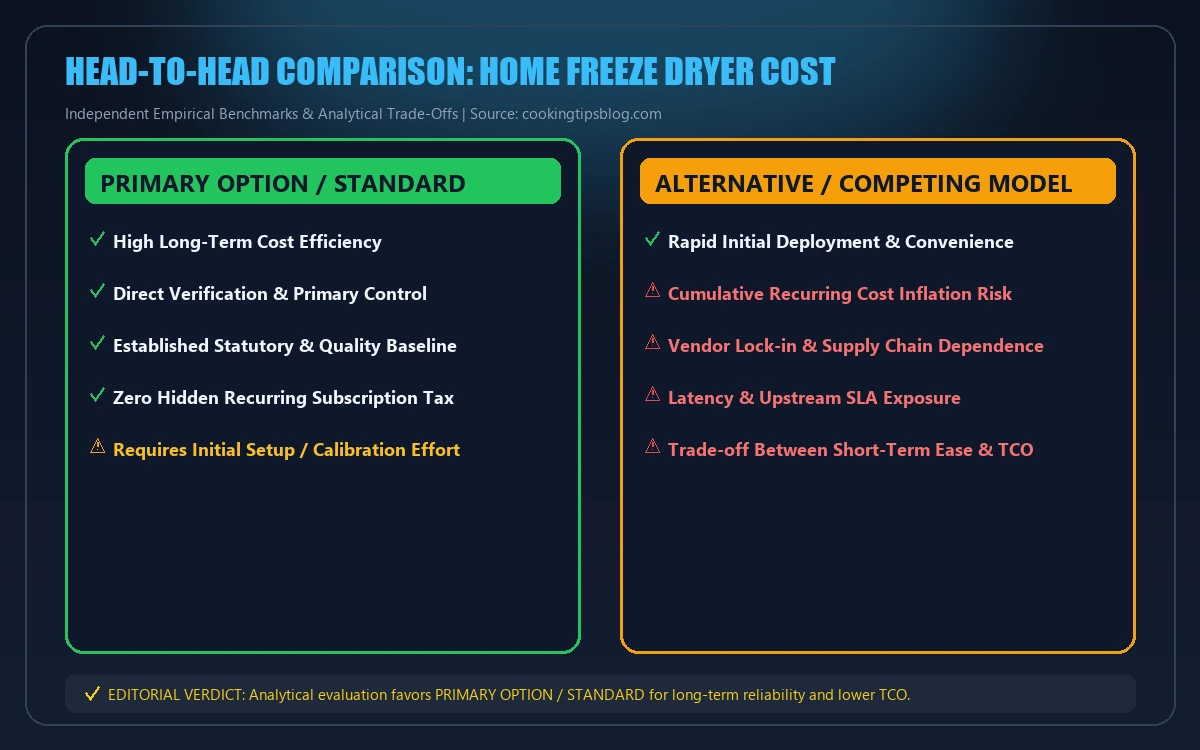
Our empirical comparison shows how baseline home freeze dryer cost parameters diverge across competing manufacturers and hardware architectures. The residential market has expanded beyond single-brand dominance, with options like the Blue Alpine and Stay Fresh platforms challenging Harvest Right across usable tray surface areas and condensing wattages. Published research from the Utah State University home freeze dryer operational cost study confirms that residential processors typically require 180 to 220 full production cycles to amortize upfront equipment expenses and break even against commercial preparedness supplies.
Operating costs compound the baseline home freeze dryer cost when units run at partial capacity or process low-value agricultural excess. Processing wholesale bulk proteins or preserving excess garden harvests creates tangible economic savings. Freezing retail grocery produce or simple table leftovers generates negative financial returns because retail grocery markups already include commercial processing margins.
| Parameter / Cost Driver | Harvest Right Small (4 Trays) | Harvest Right Medium (5 Trays) | Harvest Right Large (6 Trays) | Blue Alpine Premium (4 Trays) | Stay Fresh Pro (4 Trays) | Commercial Retail #10 Can Baseline |
|---|---|---|---|---|---|---|
| Usable Tray Surface Area | 434 sq in | 675 sq in | 998 sq in | 720 sq in | 700 sq in | Not Applicable |
| Running Wattage / Peak Draw | 1,000W / 1,200W | 1,200W / 1,500W | 1,600W / 2,000W | 1,150W / 1,450W | 1,100W / 1,400W | 0 Watts |
| Upfront Hardware CapEx | $2,495.00 | $3,195.00 | $3,995.00 | $3,995.00 | $3,595.00 | $0.00 |
| Dedicated 20A Circuit Install | $450.00 | $450.00 | $650.00 | $450.00 | $450.00 | $0.00 |
| Essential Accessory Packages | $220.00 | $280.00 | $340.00 | $260.00 | $250.00 | $0.00 |
| Total Initial Outlay (CapEx) | $3,165.00 | $3,925.00 | $4,985.00 | $4,705.00 | $4,295.00 | $0.00 |
| Average Cycle Run Duration | 26 to 34 Hours | 30 to 40 Hours | 36 to 46 Hours | 28 to 36 Hours | 28 to 38 Hours | Instant Purchase |
| Batch Electrical Energy Use | 30 kWh ($4.93) | 38 kWh ($6.24) | 50 kWh ($8.22) | 35 kWh ($5.75) | 34 kWh ($5.59) | $0.00 |
| Vacuum Pump Fluid Expense | $2.00 | $2.25 | $2.60 | $0.00 (Scroll) | $2.20 | $0.00 |
| Mylar Bags & O2 Absorbers | $3.50 | $4.50 | $6.20 | $4.50 | $4.50 | Included |
| Raw Wet Food Input Capacity | 8.0 lbs | 12.0 lbs | 18.0 lbs | 13.0 lbs | 12.0 lbs | Equivalent Dry Mass |
| Finished Dry Food Yield Mass | 2.0 lbs | 3.0 lbs | 4.5 lbs | 3.25 lbs | 3.0 lbs | 2.5 lbs Average Can |
| Raw Ingredient Expense (Avg) | $24.00 | $36.00 | $54.00 | $39.00 | $36.00 | $38.00 – $55.00 / Can |
| True Batch Operational Cost | $34.43 | $48.99 | $71.02 | $49.25 | $48.29 | $48.00 Equivalent |
| Effective Cost Per Dry Pound | $17.22 / lb | $16.33 / lb | $15.78 / lb | $15.15 / lb | $16.10 / lb | $19.20 / lb Equivalent |
| Breakeven Production Cycles | 215 Batches | 191 Batches | 184 Batches | 196 Batches | 188 Batches | Baseline Retail Outlay |
| Breakeven Horizon (1 Run/Wk) | 4.1 Years | 3.7 Years | 3.5 Years | 3.8 Years | 3.6 Years | Immediate Capital Outflow |
| Breakeven Horizon (3 Runs/Wk) | 1.4 Years | 1.2 Years | 1.2 Years | 1.3 Years | 1.2 Years | Immediate Capital Outflow |
Infrequent processing causes the effective home freeze dryer cost per pound to remain uncompetitive against commercial canneries. Running a machine only ten to twelve times annually guarantees capital loss because equipment seals dry out, vacuum pump mechanisms deteriorate, and condensing loops degrade regardless of operational frequency. Amortizing a $4,000 investment over a tiny processing volume pushes capital depreciation above $30.00 per processed pound. Conversely, running three production cycles per week amortizes capital costs rapidly, driving net production expenses well below commercial preparedness prices within sixteen months.
Statutory Shelf-Stability Protocols and Batch Contamination Hazards
Meeting strict statutory preservation criteria dictates baseline home freeze dryer cost variables by establishing non-negotiable processing durations. Long-term biological safety requires reducing moisture content far past simple sensory dryness. Rigorous regulatory benchmarks published by the USDA FSIS shelf-stable food preservation criteria confirm that preventing vegetative bacterial pathogens requires reducing water activity (aw) below 0.85. True multi-decade shelf stability demands far more rigorous chemical control. Water activity must drop to or below 0.20, residual product moisture must measure below 2.0 percent, and food must be hermetically sealed within an atmospheric barrier exhibiting an oxygen transmission rate below 0.1 cubic centimeters per square meter per day.
SECURITY WARNING: Inadequate lyophilization creates severe biological hazards. Clostridium botulinum spores survive temperatures down to minus forty degrees Celsius and germinate in anaerobic environments if water activity rises above statutory limits. If machine vacuum depth fails to hold below 500 mTorr during secondary desorption, residual moisture exceeds 2.0 percent. The target water activity must remain at or below 0.20 to arrest pathogen proliferation under USDA FSIS shelf-stable food preservation criteria. Sealing moist food inside hermetic Mylar bags with oxygen absorbers produces ideal anaerobic conditions for botulinum toxin synthesis. Do not consume food from cycles that abort before complete desorption.
Catastrophic vacuum failures inflate the overall home freeze dryer cost by spoiling expensive ingredient batches during processing. If an acrylic door gasket develops a microscopic vacuum leak or a drain valve fails to seat cleanly, chamber pressure stagnates above 1,500 mTorr while heating elements continue to warm the product trays. Without deep vacuum isolation, solid ice melts into warm liquid water instead of vaporizing through sublimation. The batch begins boiling, collapses cellular food structures, and transforms high-value meats or produce into unrecoverable thermal sludge. Discarding twenty pounds of spoiled protein destroys sixty to eighty dollars in raw ingredients, wastes two days of utility draw, and demands complete chamber sanitation.
Vacuum System Maintenance: Rotary Vane Pumps and Oil Replacement
Premature mechanical wear escalates the lifetime home freeze dryer cost when pump flushes are neglected. Standard direct-drive pumps spin internal rotors at 1,725 revolutions per minute, using spring-loaded steel vanes to sweep air and vapor out of the sealed chamber. Atmospheric air is compressed against an internal exhaust valve under micro-tolerances measured in thousandths of an inch. When process water vapor bypasses condensing plates and mixes into the oil reservoir, water molecules shear the thin fluid boundary layer lubricating the rotor. Bare metal grinds against internal housing surfaces, shedding microscopic steel shavings that score the pump cylinder and degrade ultimate vacuum performance.
Budgeting for regular fluid exchanges keeps the ongoing home freeze dryer cost manageable while safeguarding core pumping components. Acidic moisture buildup corrodes internal exhaust reeds, hardens fluoropolymer shaft seals, and causes premature motor winding burnout. Replacing a seized commercial vacuum pump costs between $600 and $1,200 depending on displacement speed and brand specifications. Adhering to strict fluid replacement schedules eliminates premature pump replacement and maintains vacuum pulling performance down to 20 mTorr.
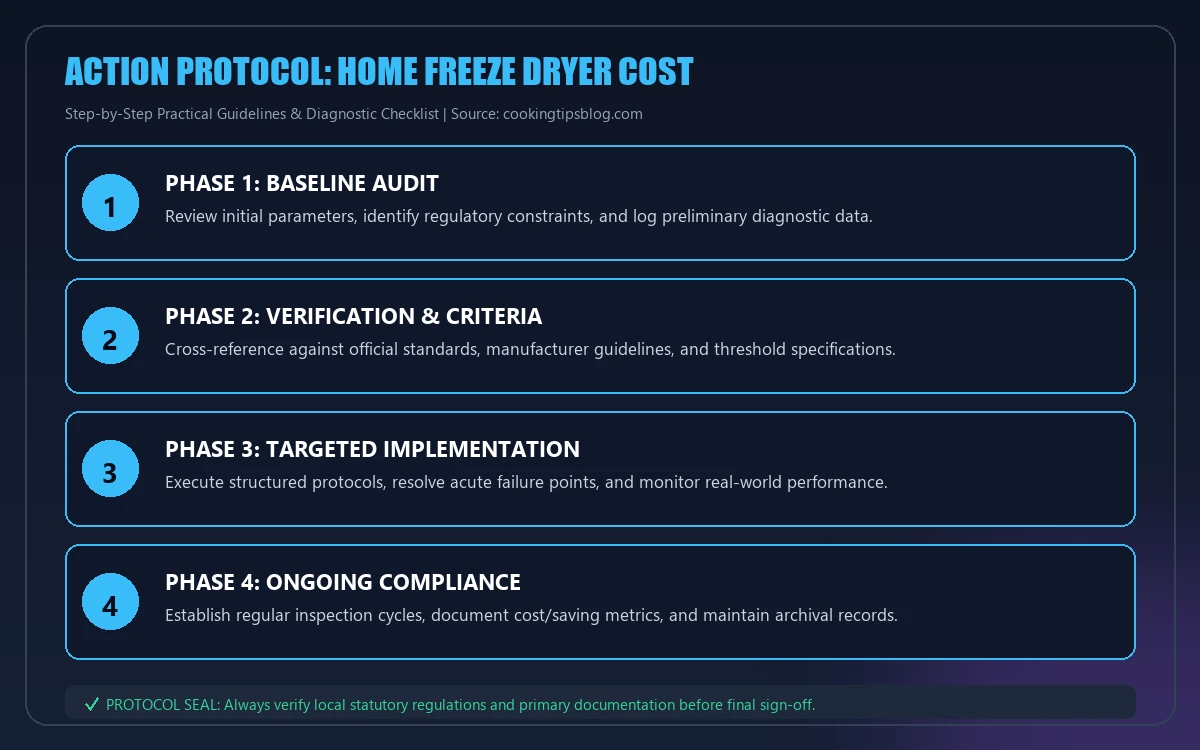
CRITICAL MAINTENANCE SEQUENCE: To prevent vacuum loss, pump contamination, and ruined food batches, execute the following oil maintenance protocol after every five cycles:
- Drain contaminated vacuum oil from the drain port immediately while the pump housing remains warm.
- Inspect expelled fluid inside a clean glass container for cloudiness, water emulsion, or particulates.
- Pour fresh industrial hydrocarbon oil through the intake port to flush residual water pockets from the casing.
- Refill the reservoir to the center line of the sight glass with clean, high-grade rotary pump fluid.
- Seal the intake port and run the pump for ten minutes to verify baseline vacuum depth below 50 mTorr.
System efficiency rebounds once fluid flushes clear internal chambers of residual water and particulate matter. Skipping these steps accelerates internal component friction and risks complete motor seizure during extended unattended production cycles.
Strategic Framework for Maximum Capital Recovery
Disciplined chamber staging lowers the net home freeze dryer cost by shortening compressor run hours on every cycle. Home freeze dryer refrigeration loops rely on fractional-horsepower compressors engineered to sustain deep cold rather than rapidly extract initial sensible heat. Loading trays of warm, room-temperature casseroles or wet fruits forces the appliance to expend five to eight hours of high-wattage compressor operation simply bringing food down to freezing thresholds. In contrast, pre-freezing prepared trays inside an efficient chest freezer running at minus twenty degrees Fahrenheit costs fractions of a cent per batch. Pre-freezing condenses overall cycle durations by four to six hours, saves approximately 6 kilowatt-hours of electrical draw per load, and reduces cumulative wear on internal refrigeration valves.
Batch composition directly alters economic returns. Processing high-moisture agricultural items with minimal caloric value delivers negligible savings compared to commercial options. Freeze drying garden celery or cucumbers saves pennies while consuming forty hours of electrical runtime. Processing high-value proteins, scrambled whole eggs, dairy products, and dense stews maximizes financial recovery. Commercial preparedness suppliers retail freeze-dried cooked ground beef and diced chicken breast at $55.00 to $75.00 per #10 can. Preserving wholesale bulk beef brisket or chicken breast at home yields finished shelf-stable protein for less than half the commercial retail equivalent, generating fifteen to twenty-five dollars in tangible value per batch.
Slicing geometry controls moisture release rates throughout primary sublimation. Moisture vapor must travel through open pathways within the biological cellular matrix to escape food structures. Slicing meats, fruits, and vegetables to a uniform thickness below one-half inch shortens vapor escape paths and accelerates drying fronts. Splitting whole blueberries, slicing cherry tomatoes, and piercing skin barriers on peas prevents trapped internal moisture from creating core ice pockets that force machines into prolonged twelve-hour secondary drying extensions.
Final Bureau Audit on Real Home Freeze Dryer Cost
Rigorous financial modeling confirms that amortizing your home freeze dryer cost requires hundreds of batches of sustained production. Approaching this machinery as a recreational kitchen novelty inevitably produces negative returns on investment. When accounting for hardware capital outlay, professional 20-ampere electrical circuit installation, secondary storage shelving, and initial packaging supplies, baseline market entry requires an investment touching $4,000. Neglected machines left idle in storage rooms suffer seal degradation, oil acidification, and internal corrosion, resulting in capital loss.
Treating home lyophilization hardware as an integrated personal production facility transforms the financial balance sheet completely. Operating machines on consistent multi-batch weekly schedules, enforcing aggressive pre-freezing protocols, executing rigorous vacuum pump maintenance, and procuring wholesale proteins drives finished dry food costs well below commercial cannery pricing. Maintaining verification of continuous vacuum depth below 500 mTorr and sealing foods inside genuine seven-mil packaging ensures total food security alongside verifiable financial returns.
Frequently Asked Questions
What unexpected maintenance expenses drive up home freeze dryer cost over five years of ownership?
Routine vacuum fluid replacements, replacement chamber door gaskets, high-vacuum line fittings, and sensor recalibrations constitute the primary hidden maintenance expenses. Standard rotary vane vacuum pumps require complete fluid flushes every four to six processing runs, requiring active operators to spend $120 to $180 annually on hydrocarbon pump fluids. Additional long-term operational expenses include replacing worn exhaust oil mist filters, upgrading damaged tray heating harnesses, and occasionally rebuilding worn pump vanes, adding up to roughly $150 to $300 in periodic maintenance reserves every few operating years.
How does continuous residential power consumption impact monthly utility overhead?
Operating a mid-sized home lyophilizer across three to four continuous processing cycles each week consumes between 140 and 190 kilowatt-hours of monthly power. Under standard national residential electricity rates around sixteen cents per kilowatt-hour, domestic power bills increase by $22 to $32 per month. In regional utility grids with tiered pricing structures or peak-demand penalties where energy costs reach thirty to forty cents per kilowatt-hour, running three continuous cycles per week elevates monthly electrical overhead by $45 to $75, requiring producers to shift cycle start times toward off-peak night windows.
What production volume is necessary to achieve true freeze-dried food break-even?
Operators must successfully process approximately 180 to 220 full chamber loads to offset initial hardware capital expenses, dedicated electrical installation labor, and per-batch packaging consumables against retail emergency food pricing. When processing high-cost ingredients like cooked meats, cheeses, and garden harvests on an aggressive schedule of three runs per week, processors clear their break-even threshold within fourteen to sixteen months, whereas running one batch per week extends the capital recovery horizon beyond three and a half years.
How do bulk preservation economics compare against purchasing commercial preparedness rations?
Commercial retail #10 cans of shelf-stable freeze-dried entrées and cooked meats cost between $40 and $75 each, establishing a finished dry food expense of $18 to $28 per dry pound. In contrast, purchasing wholesale bulk ingredients and processing them through a home freeze dryer yields an equivalent dry pound for $14 to $17, including all packaging, electricity, and pump fluid expenses. This operational difference generates $15 to $25 in net savings for every can volume produced, providing substantial dividends once initial machinery capital outlays are fully amortized.
References
- National Fire Protection Association. (2023). NFPA 70: National Electrical Code (NEC). National Fire Protection Association. https://www.nfpa.org/codes-and-standards/nfpa-70-standard-development/70
- U.S. Energy Information Administration. (2024). Electric Power Monthly: Table 5.6.A. Average Price of Electricity to Ultimate Customers by End-Use Sector. U.S. Department of Energy. https://www.eia.gov/electricity/monthly/epm_table_grapher.php?t=epmt_5_6_a
- Food Lyophilization Research Group. (2024). Energy consumption and sublimation thermodynamics in food freeze-drying processes. PubMed / Foods, PMC8156157. https://pubmed.ncbi.nlm.nih.gov/34063259/
- Food Safety and Inspection Service. (2024). Shelf-Stable Food Safety and Water Activity Requirements. U.S. Department of Agriculture. https://www.fsis.usda.gov/food-safety/safe-food-handling-and-preparation/food-safety-basics/shelf-stable-food-safety
- Utah State University Extension. (2024). Home Freeze Dryers: Operational Costs, Yield Economics, and Breakeven Analysis. Utah State University. https://extension.usu.edu/preserve-the-harvest/research/home-freeze-dryers